
The OEB is committed to transparency and accountability in our regulatory processes and the costs associated with adjudication. As part of this commitment, we have developed the Adjudicative Cost Reporting Dashboard to track and publicly report on adjudicative costs. This dashboard provides insight into adjudicative-related utility applications costs, intervenor costs and OEB costs. By reporting on this information, we aim to give stakeholders a clearer understanding of the costs and benefits of the OEB’s regulatory framework.
First published in 2026, the dashboard includes data for electricity cost of service applications. Future versions may expand to include data for additional application types including natural gas rates.
The dashboard is published annually.
The dashboard includes all cases, including very large cases that can shift the results. For example, the 2023 data include Hydro One Networks Inc.’s (Hydro One) Joint Rate Application (JRAP) for combined transmission and distribution rates for 2023–2027 (EB-2021-0110). With a proposed revenue requirement of approximately $20 billion and an investment plan of about $13 billion over the rate period, this application represents one of the largest and most complex rate cases before the OEB. This case is also notable because partway through the proceeding, Hydro One filed a material update to its application. For the purposes of this dashboard, the requested revenue requirement being used is based on the updated application.
Current Report
Fiscal 2021-2025 (April 1, 2021, to March 31, 2025)
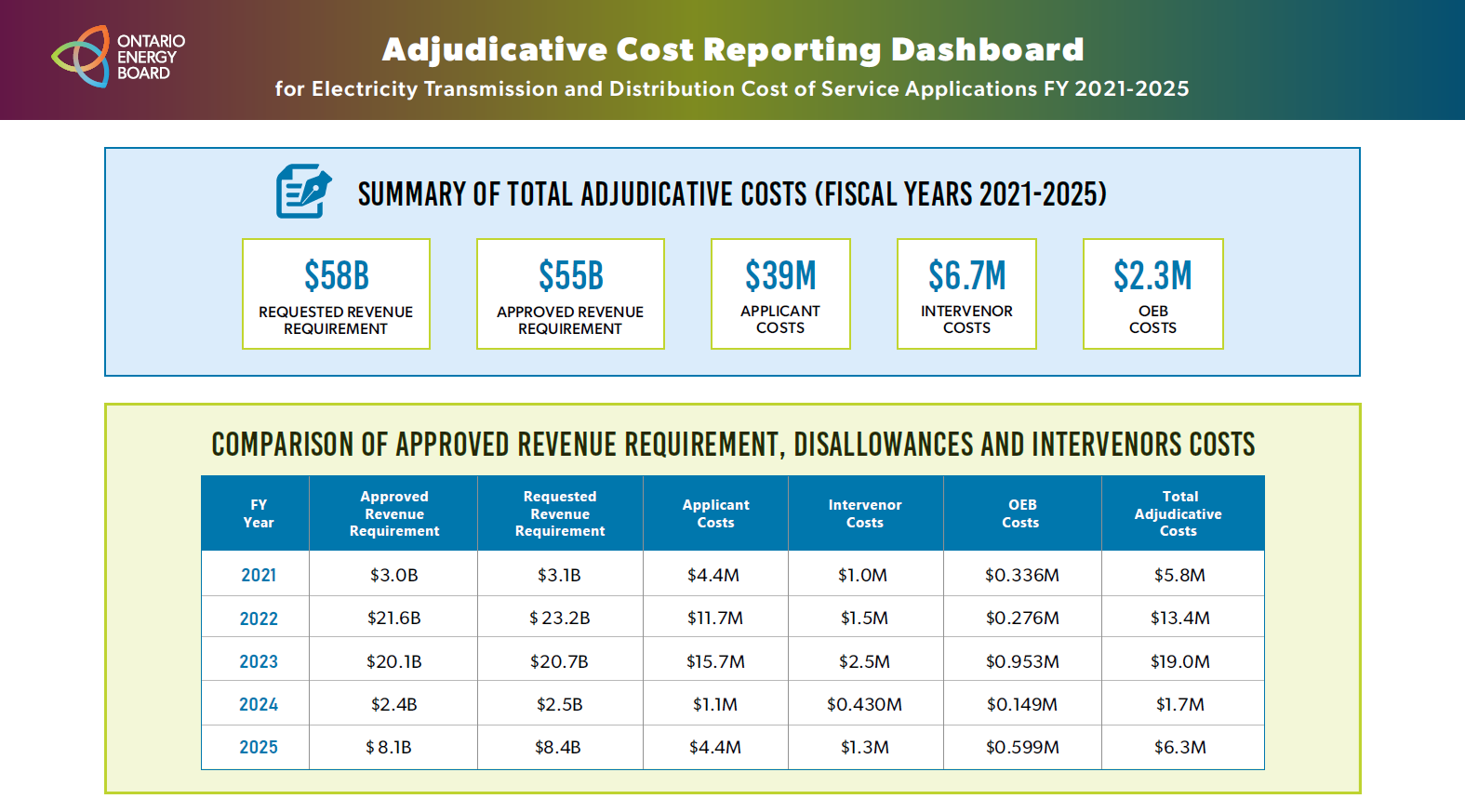
Summary of Total Adjudicative Costs (Fiscal Years 2021-2025)
Comparison of revenue requirement and adjudicative costs
| FY Year | Approved Revenue Requirement | Requested Revenue Requirement | Applicant Costs | Intervenor Costs | OEB Costs | Total Adjudicative Costs |
|---|---|---|---|---|---|---|
| 2021 | $3.0B | $3.1B | $4.4M | $1.0M | $0.336M | $5.8M |
| 2022 | $21.6B | $23.2B | $11.7M | $1.5M | $0.276M | $13.4M |
| 2023 | $20.1B | $20.7B | $15.7M | $2.5M | $0.953M | $19.0M |
| 2024 | $2.4B | $2.5B | $1.1M | $0.430M | $0.149M | $1.7M |
| 2025 | $8.1B | $8.4B | $4.4M | $1.3M | $0.599M | $6.3M |
Data Dictionary
Disclaimer: The definitions included in this data dictionary have been developed specifically for the Adjudicative Cost Reporting dashboard. They are intended to support interpretation of the metrics presented herein and should not be applied or interpreted more broadly outside of this context.
Applicant Costs: Applicant costs are the costs incurred by an applicant in preparing, filing, and supporting an application before the Ontario Energy Board. These costs may include internal staff time, consultant and legal fees, and other expenses directly related to participation in the application process.
Approved Revenue Requirement: The approved revenue requirement is the total amount of revenue that the Ontario Energy Board has approved a utility to recover from customers over a specified period to cover the utility’s forecasted costs of providing service. This typically includes operating and maintenance expenses, depreciation, taxes, and an approved return on invested capital. The approved revenue requirement is used to set rates for customers.
Intervenor Costs: Intervenor costs are the reasonably incurred costs of eligible intervenors who have the OEB’s permission to participate in a public hearing about a utility’s application. These costs may include consultant, legal, and expert witness expenses and are typically claimed under the OEB’s intervenor cost-recovery framework. Approved intervenor costs are generally recovered from the applicant, subject to OEB approval.
OEB Costs: OEB costs include costs under section 30 of the Ontario Energy Board Act related to consultant, court reporter, translation, transcription and publication costs associated with the adjudicative process. For the purposes of the Adjudicative Cost Dashboard, OEB costs do not include costs under section 26 of the Ontario Energy Board Act related to OEB staff salaries.
Requested Revenue Requirement: The requested revenue requirement is the total amount of revenue a utility proposes to recover from ratepayers as set out in its rate application to the Ontario Energy Board. It reflects the utility’s forecast of costs it considers necessary to provide service over the applicable test year or rate period, including operating, maintenance, and administrative expenses, depreciation, taxes, and a proposed return on capital, prior to OEB review, adjudication, settlement, or approval.