
Hydro One Networks Inc.
Current applications before the Board
Title: Hydro One Networks Inc. (EB-2026-0193) - Electricity distribution rate order exemption related to gross load billing
Case number: EB-2026-0193
Type:
Filed: July 24, 2026
Hydro One Networks Inc. (Hydro One Networks) has applied to the Ontario Energy Board (OEB) for an exemption from provisions in its distribution Rate Order for an existing customer who is connected to its distribution system, and a prospective customer who has requested a connection to its distribution system, both located in the Leamington area. Hydro One Networks has applied for the following approvals:
- An exemption from provisions in its Rate Order (EB-2025-0030) pertaining to the application of Gross Load Billing (GLB) for distribution customers with embedded generation facilities
- An amendment to its Rate Order to allow Hydro One Networks to apply a proposed alternative approach to GLB to any other identical scenarios that may arise
A Rate Order is the OEB decision that sets the rates a utility can charge customers and explains when and how those rates will take effect. GLB is a mechanism that Hydro One Networks uses to recover the cost of providing a customer's maximum potential demand, combining both the power drawn from the grid and the power supplied by customer’s own generation, for the grid capacity built to support the customer’s peak demand.
Hydro One Networks submits that no person will be adversely affected in a material way by the outcome of the proceeding and has requested that the application be decided without a hearing. If you believe a hearing is needed, then you can request one by filing a letter with the OEB no later than July 31, 2026. You should indicate whether you have a preference for the hearing to be oral, electronic or written. If you do not file a letter by the due date, you will not receive any further notice in the event the OEB proceeds with a hearing. If you submit a letter, your name and the content of your letter will be put on the public record and the OEB website.
Type: Rates
This application will be heard using the Complex Incentive Rate-setting Mechanism performance standard (pdf). View an expanded timeline (pdf) of the procedural steps for this Rates application.
Find out more about OEB Performance Standards for Processing Applications and use the Application Planning Tool to assist you with an estimate of the milestones in this proceeding.
See the application notice
See the application
See all documents related to this application
The above links will take you to our document repository
Participate
There are three ways to participate in the OEB hearing process: as an Intervenor, submitting a Letter of Comment or to Follow a Proceeding.
This table illustrates the different levels of participation. Find out more about participating in an OEB hearing, including becoming an intervenor.
| Participation Activities | Intervenor | Letter of Comment | Follow a Proceeding |
|---|---|---|---|
| Receive OEB-issued documents by email |  |  | |
| Submit a Letter of Comment | | | |
| Listen to live broadcast of the oral hearing | | | |
| Participate in oral hearing | | | |
| Present Evidence | | | |
| Respond to questions about evidence | | | |
| Ask other parties to the proceeding questions | | | |
| Provide argument | | | |
See application details and how to participate
Title: Hydro One Networks Inc. (EB-2026-0169) – 2027 electricity transmission revenue requirement
Case number: EB-2026-0169
Type:
Filed: July 15, 2026
Hydro One Networks Inc. (Hydro One Networks) has applied to the Ontario Energy Board (OEB) for approval to change its electricity transmission rates effective, January 1, 2027. The application seeks an Order for approval of the following:
- Rates of its revenue requirement for 2027
- Approval to dispose of the balance in the Excess Export Service Revenue Variance Account as of December 31, 2025.
- Approval of the inclusion of Hydro One Transmission’s approved rates revenue requirement in the OEB’s determination of the 2027 Uniform Transmission Rates
- Approval of the Export Transmission Service rate for 2027
If the application is approved as filed, the monthly bill a typical residential and general service electricity distribution customer would see the following change effective January 1, 2027:
| Residential (750 kWh) | $1.10 per month |
| General Service less than 50kW (2,000 kWh) | $2.44 per month |
Other customers, including businesses, will also be affected.
Any change to the provincial transmission rate will be reflected on the delivery line of the electricity bill for all electricity customers in Ontario. It’s important to review the application carefully to determine whether you may be affected by the proposed changes.
Type: Rates, Complex Incentive
This application will be heard using the Complex Incentive Rate-setting Mechanism performance standard (pdf). View an expanded timeline (pdf) of the procedural steps for this Rates application.
Find out more about OEB Performance Standards for Processing Applications and use the Application Planning Tool to assist you with an estimate of the milestones in this proceeding.
See the application notice
See the application
See all documents related to this application
The above links will take you to our document repository
Participate
There are three ways to participate in the OEB hearing process: as an Intervenor, submitting a Letter of Comment or to Follow a Proceeding.
This table illustrates the different levels of participation. Find out more about participating in an OEB hearing, including becoming an intervenor.
| Participation Activities | Intervenor | Letter of Comment | Follow a Proceeding |
|---|---|---|---|
| Receive OEB-issued documents by email | | | |
| Submit a Letter of Comment | | | |
| Listen to live broadcast of the oral hearing | | | |
| Participate in oral hearing | | | |
| Present Evidence | | | |
| Respond to questions about evidence | | | |
| Ask other parties to the proceeding questions | | | |
| Provide argument | | | |
See application details and how to participate
Title: Hydro One Networks Inc. (EB-2026-0155) - Durham Kawartha Transmission line
Case number: EB-2026-0155
Type:
Filed: July 06, 2026
Hydro One Networks Inc. (Hydro One Networks) is asking the Ontario Energy Board (OEB) for:
- Permission to construct approximately 55 kilometres of new 230 kilovolt double circuit electricity transmission line from the Dobbin Transformer Station to the Clarington Transformer Station in Eastern Ontario. The Project would primarily be located within an existing transmission corridor.
- Permission to complete associated station facility expansions or upgrades at the terminal stations and minor protection upgrades at four remote stations required for the connection of the new 230 kilovolt double-circuit transmission line.
- Approval of the forms of land use agreements that Hydro One Networks will offer affected landowners.
Hydro One Networks says the project is required to increase the overall transfer capability of the bulk transmission system to ensure suffcient supply capacity to the Peterborough to Quinte West region and surrounding area. The proposed transmission line has been designated as a priority project by the Ministry of Energy.
The OEB hearing is not the only approval process required before a line is built. Environmental issues, or issues related to the Crown’s duty to consult Indigenous peoples, are not part of the OEB’s review unless there is a direct impact on price and the reliability and quality of electricity service.
A map of the proposed route for the transmission line is provided below:
Type: Leave to Construct
This application will be heard using the Complex Electricity & Natural Gas performance standard (pdf). View an expanded timeline (pdf) of the procedural steps for this Leave to Construct application and read the Standard Issues List (pdf).
Find out more about OEB Performance Standards for Processing Applications and use the Application Planning Tool to assist you with an estimate of the milestones in this proceeding.
See the application notice
See the application
See all documents related to this application
The above links will take you to our document repository
Participate
There are three ways to participate in the OEB hearing process: as an Intervenor, submitting a Letter of Comment or to Follow a Proceeding.
This table illustrates the different levels of participation. Find out more about participating in an OEB hearing, including becoming an intervenor.
| Participation Activities | Intervenor | Letter of Comment | Follow a Proceeding |
|---|---|---|---|
| Receive OEB-issued documents by email | | | |
| Submit a Letter of Comment | | | |
| Listen to live broadcast of the oral hearing | | | |
| Participate in oral hearing | | | |
| Present Evidence | | | |
| Respond to questions about evidence | | | |
| Ask other parties to the proceeding questions | | | |
| Provide argument | | | |
See application details and how to participate
Title: Hydro One Networks Inc. (EB-2026-0018) - Orléans Area Reinforcement Project
Case number: EB-2026-0018
Type:
Filed: June 29, 2026
Hydro One Networks Inc. (Hydro One Networks) has applied to the Ontario Energy Board (OEB) for an order granting leave to construct approximately 11 kilometres of new transmission line and associated facilities between Hawthorne Transformer Station and Orléans Transformer Station in the City of Ottawa (Project). The Project would primarily be located within an existing transmission corridor. The Project would consist of approximately ten kilometres of 115 kilovolt single-circuit transmission line and one kilometre of 230 kilovolt transmission line.
Hydro One Networks is also asking the OEB to approve the forms of land use agreements that Hydro One Networks will offer to affected landowners. Hydro One Networks submits that the transmission line and associated facilities are required to ensure sufficient supply capacity to meet growing electricity needs in the Orleans area driven by long-term development and electrification trends. Hydro One Networks submits that the Project is not expected to have a material impact on a typical residential customer’s bill, nor does the Independent Electricity System Operator expect the Project to have any material adverse impact the reliability of the integrated power system.
The OEB hearing is not the only approval process required before a line is built. Environmental issues, or issues related to the Crown’s duty to consult Indigenous peoples, are not part of the OEB’s review unless there is a direct impact on price and the reliability and quality of electricity service.
A map of the proposed route for the transmission line is provided below:
Type: Leave to Construct
This application will be heard using the Complex Electricity & Natural Gas performance standard (pdf). View an expanded timeline (pdf) of the procedural steps for this Leave to Construct application and read the Standard Issues List (pdf).
Find out more about OEB Performance Standards for Processing Applications and use the Application Planning Tool to assist you with an estimate of the milestones in this proceeding.
See the application notice
See the application
See all documents related to this application
The above links will take you to our document repository
Participate
There are three ways to participate in the OEB hearing process: as an Intervenor, submitting a Letter of Comment or to Follow a Proceeding.
This table illustrates the different levels of participation. Find out more about participating in an OEB hearing, including becoming an intervenor.
| Participation Activities | Intervenor | Letter of Comment | Follow a Proceeding |
|---|---|---|---|
| Receive OEB-issued documents by email | | | |
| Submit a Letter of Comment | | | |
| Listen to live broadcast of the oral hearing | | | |
| Participate in oral hearing | | | |
| Present Evidence | | | |
| Respond to questions about evidence | | | |
| Ask other parties to the proceeding questions | | | |
| Provide argument | | | |
See application details and how to participate
Title: Hydro One Networks Inc. (EB-2026-0154) - Northeast Power Line Transmission Project
Case number: EB-2026-0154
Type:
Filed: June 17, 2026
Hydro One Networks Inc. (Hydro One Networks) is asking the Ontario Energy Board (OEB) for:
- Permission to construct approximately 205 km of a new 500 kilovolt single-circuit transmission line from Hanmer Transformer Station in Greater Sudbury to Mississagi Transformer Station located in Wharncliffe in the District of Algoma, including associated facilities (Northeast Power Line Project).
- Approval to complete any associated station facility expansions or upgrades required at the terminal stations.
- Approval of the forms that Hydro One Networks will off er landowners to use their land for routing or construction of the proposed line.
The Northeast Power Line Project has been identified by the Ministry of Energy as a priority project that will provide an increase of power transfer capability from Northeast to Northwest Ontario. The OEB hearing is not the only approval process required before a line is built. Environmental issues, or issues related to the Crown’s duty to consult Indigenous peoples, are not part of the OEB’s review unless there is a direct impact on price and the reliability and quality of electricity service. A map of the proposed route for the transmission line is provided below:
Type: Leave to Construct
This application will be heard using the Complex Electricity & Natural Gas performance standard (pdf). View an expanded timeline (pdf) of the procedural steps for this Leave to Construct application and read the Standard Issues List (pdf).
Find out more about OEB Performance Standards for Processing Applications and use the Application Planning Tool to assist you with an estimate of the milestones in this proceeding.
See the application notice
See the application
See all documents related to this application
The above links will take you to our document repository
Participate
There are three ways to participate in the OEB hearing process: as an Intervenor, submitting a Letter of Comment or to Follow a Proceeding.
This table illustrates the different levels of participation. Find out more about participating in an OEB hearing, including becoming an intervenor.
| Participation Activities | Intervenor | Letter of Comment | Follow a Proceeding |
|---|---|---|---|
| Receive OEB-issued documents by email | | | |
| Submit a Letter of Comment | | | |
| Listen to live broadcast of the oral hearing | | | |
| Participate in oral hearing | | | |
| Present Evidence | | | |
| Respond to questions about evidence | | | |
| Ask other parties to the proceeding questions | | | |
| Provide argument | | | |
See application details and how to participate
Title: Hydro One Networks Inc. (EB-2026-0128) - Longwood to Lakeshore Transmission Line Project
Case number: EB-2026-0128
Type:
Filed: June 11, 2026
Hydro One Networks Inc. (Hydro One Networks) is asking the Ontario Energy Board (OEB) for:
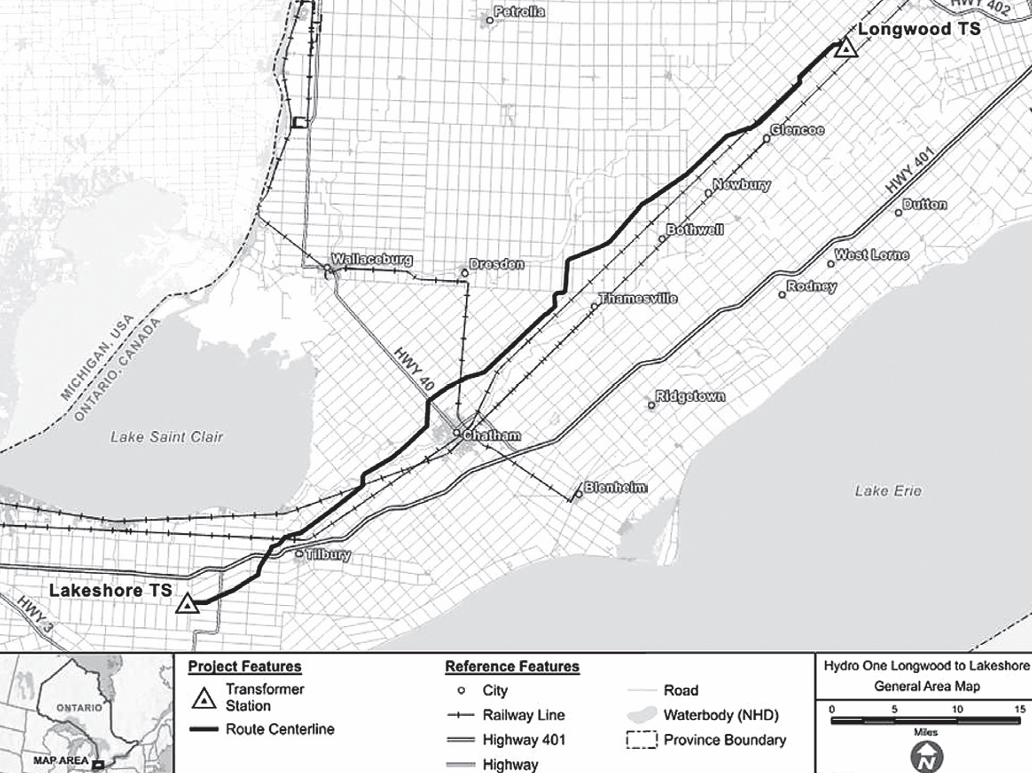
- Permission to construct 117 km of single-circuit 500 kilovolt electricity transmission line from Longwood Transformer Station to Lakeshore Transformer Station in southwestern Ontario in the area west of London.
- Permission to complete associated station facility expansions or upgrades at the terminal stations and minor grounding upgrades at six remote stations required for the connection of the new transmission line.
- Approval of the forms of land use agreements that Hydro One Networks will off er affected landowners.
Hydro One Networks says the project is required to increase long-term supply capability to support electricity demand growth in the Windsor-Essex and Chatham-Kent regions. The proposed transmission line has been designated as a priority project by the provincial government.
The OEB hearing is not the only approval process required before a line is built. Environmental issues, or issues related to the Crown’s duty to consult Indigenous peoples, are not part of the OEB’s review unless there is a direct impact on price and the reliability and quality of electricity service.
A map of the proposed route for the transmission line is provided below:
Type: Leave to Construct
This application will be heard using the Complex Electricity & Natural Gas performance standard (pdf). View an expanded timeline (pdf) of the procedural steps for this Leave to Construct application and read the Standard Issues List (pdf).
Find out more about OEB Performance Standards for Processing Applications and use the Application Planning Tool to assist you with an estimate of the milestones in this proceeding.
See the application notice
See the application
See all documents related to this application
The above links will take you to our document repository
Participate
There are three ways to participate in the OEB hearing process: as an Intervenor, submitting a Letter of Comment or to Follow a Proceeding.
This table illustrates the different levels of participation. Find out more about participating in an OEB hearing, including becoming an intervenor.
| Participation Activities | Intervenor | Letter of Comment | Follow a Proceeding |
|---|---|---|---|
| Receive OEB-issued documents by email | | | |
| Submit a Letter of Comment | | | |
| Listen to live broadcast of the oral hearing | | | |
| Participate in oral hearing | | | |
| Present Evidence | | | |
| Respond to questions about evidence | | | |
| Ask other parties to the proceeding questions | | | |
| Provide argument | | | |
See application details and how to participate
Title: Hydro One Networks Inc. (EB-2026-0112) - leave to construct
Case number: EB-2026-0112
Type:
Filed: June 04, 2026
Hydro One Networks Inc. (Hydro One Networks) is asking the Ontario Energy Board (OEB) for:
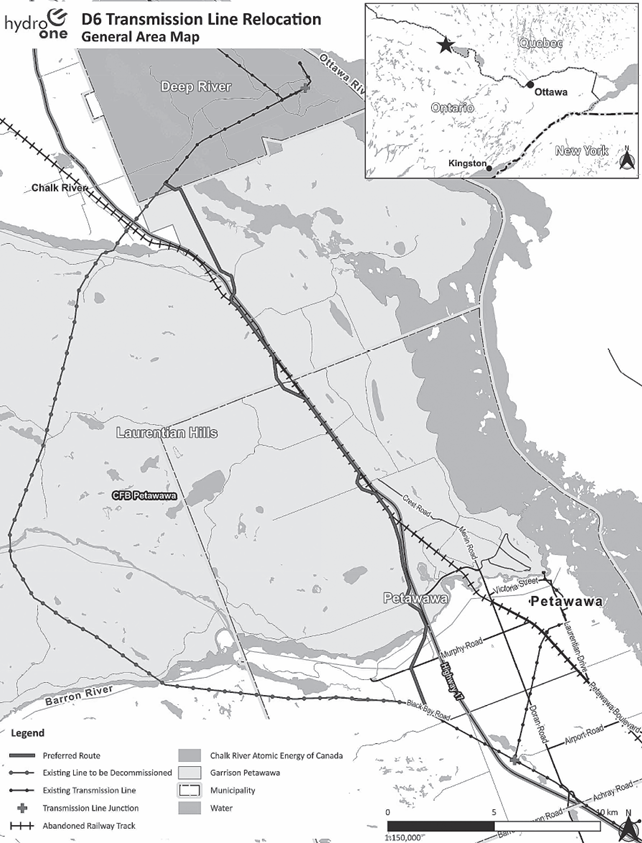
- Permission to relocate an existing 115 kilovolt single-circuit transmission line that Hydro One Networks says has reached end-of-life. The relocated transmission line will run between Hydro One Networks’ Chalk River customer transformer station and the transmission line intersection point known as Petawawa Junction in the Renfrew area. The transmission line passes through the towns of Petawawa, Laurentian Hills and Deep River. The total length of the line is approximately 21 kilometers, including 18 kilometers on federally owned lands and the remainder on privately owned lands.
- Approval of the forms of land use agreements that Hydro One Networks will offer affected landowners.
The OEB hearing is not the only approval process required before a line is built.
Environmental issues, or issues related to the Crown’s duty to consult Indigenous peoples, are not part of the OEB’s review unless there is a direct impact on price and the reliability and quality of electricity service.
A map of the proposed route for the transmission line is provided below:
Type: Leave to Construct
This application will be heard using the Short-form Electricity & Natural Gas performance standard (pdf). View an expanded timeline (pdf) of the procedural steps for this Leave to Construct application and read the Standard Issues List (pdf).
Find out more about OEB Performance Standards for Processing Applications and use the Application Planning Tool to assist you with an estimate of the milestones in this proceeding.
See the application notice
See the application
See all documents related to this application
The above links will take you to our document repository
Participate
There are three ways to participate in the OEB hearing process: as an Intervenor, submitting a Letter of Comment or to Follow a Proceeding.
This table illustrates the different levels of participation. Find out more about participating in an OEB hearing, including becoming an intervenor.
| Participation Activities | Intervenor | Letter of Comment | Follow a Proceeding |
|---|---|---|---|
| Receive OEB-issued documents by email | | | |
| Submit a Letter of Comment | | | |
| Listen to live broadcast of the oral hearing | | | |
| Participate in oral hearing | | | |
| Present Evidence | | | |
| Respond to questions about evidence | | | |
| Ask other parties to the proceeding questions | | | |
| Provide argument | | | |
See application details and how to participate
Title: Hydro One Networks Inc. - Welland-Thorold Project
Case number: EB-2025-0290
Type:
Filed: January 20, 2026
Hydro One Networks Inc. (Hydro One Networks) is asking the Ontario Energy Board for permission to construct a new double circuit 230 kilovolt transmission line that spans approximately 18.5 km between Abitibi Consolidated Junction in Thorold to the Crowland Transformer Station located in Welland (Welland-Thorold Project). Hydro One Networks says the Welland-Thorold project consists of both new and repurposed right of way. Hydro One Networks says the transmission line is needed to ensure sufficient capacity to support continued growth and to improve reliability in the Niagara area.
Hydro One Networks is also asking the OEB to approve the form of agreement it offers to landowners to use their land for routing or construction of the proposed line.
Hydro One Networks is also asking the OEB for permission to expropriate interests in certain lands associated with the Welland-Thorold Project. Hydro One Networks’ application in relation to expropriation is not about compensation. The OEB will consider the public interest when making any order authorizing Hydro One Networks to expropriate land. The OEB does not have the authority to determine the amount of compensation payable. If the OEB authorizes Hydro OneNetworks to expropriate and the parties do not agree upon compensation, then the compensation must be determined under the Expropriations Act or by the Ontario Land Tribunal.
A map of the proposed route for the transmission line is provided below:
Type: Leave to Construct
This application will be heard using the Complex Electricity & Natural Gas performance standard (pdf). View an expanded timeline (pdf) of the procedural steps for this Leave to Construct application and read the Standard Issues List (pdf).
Find out more about OEB Performance Standards for Processing Applications and use the Application Planning Tool to assist you with an estimate of the milestones in this proceeding.
See the application notice
See the application
See all documents related to this application
The above links will take you to our document repository
Participate
There are three ways to participate in the OEB hearing process: as an Intervenor, submitting a Letter of Comment or to Follow a Proceeding.
This table illustrates the different levels of participation. Find out more about participating in an OEB hearing, including becoming an intervenor.
| Participation Activities | Intervenor | Letter of Comment | Follow a Proceeding |
|---|---|---|---|
| Receive OEB-issued documents by email | | | |
| Submit a Letter of Comment | | | |
| Listen to live broadcast of the oral hearing | | | |
| Participate in oral hearing | | | |
| Present Evidence | | | |
| Respond to questions about evidence | | | |
| Ask other parties to the proceeding questions | | | |
| Provide argument | | | |
See application details and how to participate
Title: Hydro One Networks Inc. (EB-2024-0142) - Port Colborne Expropriation
Case number: EB-2024-0142
Type:
Filed: April 11, 2025
Hydro One Networks Inc. (Hydro One) is asking the Ontario Energy Board (OEB) for permission to expropriate interests in certain lands near the City of Port Colborne. Hydro One says that the expropriation is needed so that it may continue to operate and maintain existing transmission lines that are located on the lands. The existing transmission lines were originally constructed in the 1960s and form part of the Independent Electricity System Operator controlled transmission grid.
Hydro One’s application is about the expropriation of certain lands only. It is not about compensation. The OEB will consider the public interest when making any order authorizing Hydro One to expropriate land. The OEB does not have the authority to determine the amount of compensation payable. If the OEB authorizes Hydro One to expropriate and the parties do not agree upon compensation, then the compensation must be determined under the Expropriations Act by the Ontario Land Tribunal.
Type: Expropriation
This application will be heard using the LTC Complex electricity & Natural Gas performance standard (pdf).
Find out more about OEB Performance Standards for Processing Applications and use the Application Planning Tool to assist you with an estimate of the milestones in this proceeding.
See the application notice
See the application
See all documents related to this application
The above links will take you to our document repository
Participate
There are three ways to participate in the OEB hearing process: as an Intervenor, submitting a Letter of Comment or to Follow a Proceeding.
This table illustrates the different levels of participation. Find out more about participating in an OEB hearing, including becoming an intervenor.
| Participation Activities | Intervenor | Letter of Comment | Follow a Proceeding |
|---|---|---|---|
| Receive OEB-issued documents by email | | | |
| Submit a Letter of Comment | | | |
| Listen to live broadcast of the oral hearing | | | |
| Participate in oral hearing | | | |
| Present Evidence | | | |
| Respond to questions about evidence | | | |
| Ask other parties to the proceeding questions | | | |
| Provide argument | | | |
See application details and how to participate
Contact this Utility:
7th Floor, South Tower
Toronto ON M5G 2P5
The electricity utility scorecards measure how well Ontario's electricity utilities are performing each year. It is designed to encourage utilities to operate effectively, continually seek ways to improve productivity and focus on improvements that their customers value. Utilities report their scorecard performance results annually, and make the results available to the public.
The scorecard can be used as a tool for consumers to assess for themselves the value of the service received from their electricity utility. For example:
- When service appointments are booked with my utility, how often did they show up on time?
- How often did my power go out, and how long did the utility take to fix the problem and restore power?
- How successful is my utility at issuing accurate bills?
- Did my utility answer phone calls from customers in a timely way?
Use our report generator tool to compare costs and performance between distributors
New residential/small business services connected on time 99.94% (2024)
The utility must connect new service for the customer within five business days, 90 % of the time, unless the customer agrees to a later date. This timeline depends on the customer meeting specific requirements ahead of time (such as no electrical safety concerns in the building, customer's payment information complete, etc.)
Scheduled appointments met on time 100% (2024)
For appointments during the utility's regular business hours, the utility must offer a window of time that is not more than four hours long, and must arrive within that window, 90 % of the time.
Telephone calls answered on time 78.01% (2024)
During regular call centre hours, the utility's call centre staff must answer within 30 seconds of receiving the call directly or having the call transferred to them, 65 % of the time
Billing accuracy 98.94% (2024)
An important part of business is ensuring that customer's bills are accurate. The utility must report on its success at issuing accurate bills to its customers.
More information about billing accuracy
More information about billing accuracy
Accurate bills issued expressed as a percentage of total bills issued. It is calculated as:
= (Total number of bills issued for the year – Number of inaccurate bills issued for the year) / Total number of bills issued for the year
This requirement must be met at least 98% of the time on a yearly basis.
Complaints 0.06 (2024)
This metric measures the number of complaints the Ontario Energy Board received from customers about matters within our authority. Complaints made directly to the utility are not reported here. We measure this per 1000 customers so utilities that serve much larger or smaller populations can be compared against each other.
| Year | Complaints per 1000 customers | Total number of complaints |
|---|---|---|
| 2013 | 0.53 | 647 |
| 2014 | 0.49 | 593 |
| 2015 | 0.34 | 425 |
| 2016 | 0.30 | 397 |
| 2017 | 0.10 | 127 |
| 2018 | 0.07 | 87 |
| 2019 | 0.07 | 99 |
| 2020 | 0.04 | 55 |
| 2021 | 0.05 | 77 |
| 2022 | 0.07 | 100 |
| 2023 | 0.06 | 85 |
| 2024 | 0.06 | 87 |
Average number of hours power to a customer was interrupted 7.663h (2024)
An important feature of a reliable distribution system is recovering from power outages as quickly as possible. The utility must track the average length of time, in hours, that its customers have experienced a power outage over the past year.
Average number of times power to a customer was interrupted 2.682 (2024)
Another important feature of a reliable distribution system is reducing the frequency of power outages. Utilities must also track the number of times their customers experienced a power outage during the past year.
More information about interruption frequency
More information about interruption frequency
We measure disruption using the System Average Interruption Duration Index (Loss of Supply). It expresses the average amount of time, per reporting period, during which supply to a customer was interrupted. It is determined by dividing the total monthly duration of all interruptions experienced by all customers (excluding interruptions caused by Loss of Supply events), in hours, by the average number of customers served:
= (Total Customer Hours of Interruptions – Total Customer Hours of Interruptions caused by Loss of Supply events)/ Average Number of Customers Served.
Efficiency rating 4 (2024)
The utility must manage its costs successfully in order to help assure its customers they are receiving value for the cost of the service they receive. Utilities' total costs are evaluated to produce a single efficiency ranking. This is divided into five groups based on how big the difference is between each utility's actual and predicted costs. Distributors whose actual costs are lower than their predicted costs are considered more efficient.
- 1 = Actual costs are 25% or more below predicted costs
- 2 = Actual costs are 10% to 25% below predicted costs
- 3 = Actual costs are within +/- 10% of predicted costs
- 4 = Actual costs are 10% to 25% above predicted costs
- 5 = Actual costs are 25% or more above predicted costs
| 2013 | 5 |
| 2014 | 5 |
| 2015 | 5 |
| 2016 | 4 |
| 2017 | 4 |
| 2018 | 4 |
| 2019 | 4 |
| 2020 | 4 |
| 2021 | 4 |
| 2022 | 4 |
| 2023 | 4 |
| 2024 | 4 |
Cost per customer $1,384 (2024)
A simple measure that can be used as a comparison with other utilities is the utility's total cost per customer.
Total cost is a sum of all the costs incurred by the utility to provide service to its customers. The amount is then divided by the utility's total number of customers. This amount does not represent how much customers pay for their utility services.
More information about Cost per Customer
More information about Cost per Customer
Total cost is calculated as the sum of a utility’s capital costs and Operating, Maintenance & Administration, or OM&A, costs, including certain adjustments to make the costs more comparable between utilities, per reporting period. This amount is then divided by the total number of customers the utility serves.
| 2013 | $1,046 |
| 2014 | $1,069 |
| 2015 | $983 |
| 2016 | $987 |
| 2017 | $974 |
| 2018 | $1,022 |
| 2019 | $1,051 |
| 2020 | $1,024 |
| 2021 | $1,033 |
| 2022 | $1,172 |
| 2023 | $1,369 |
| 2024 | $1,384 |